Why You Should Focus on Wellness Over Weight Loss Episode 54

Show Notes
Do you believe that losing weight will make you healthy? Have you tried all the diets only to be left with more questions than answers? Did the diet add to or take from your life? Is weight loss the barometer by which you measure your health and wellness?
Stewardship of your wellness is important, and focusing on what matters most is vital. In order for your body to truly change it’s important that you take a holistic approach to your wellness, your weight, and your health. All of these things work together!
God has given us many things to Steward and I don’t believe that he doesn’t care about our bodies and our wellness as a whole. How we measure and define things matters.
I hope this episode challenges and encourages you wherever you may be in your wellness, weight loss, health, fitness journey, etc.
Other episodes to encourage you
Ep 53 – Food is Fuel, Stewarding Health and Wellness
Ep 41 – What Stewarding Looks Like From a Different Perspective (My Husband shares)
Ep 22 – Take the Doubts With You and Keep Going Until He Tells You to Stop
Stewarding Wellness an Easy Meal Planning Method Ep 43
Wellness Stewardship Revisited -Ep Bonus
Sign up for the free “Steward on Purpose” workbook here
Blog: Style And Stewardship
Wellness Over Weight Loss Episode 54
Transcript from episode 54. Do you believe that focusing on weight loss means that you’ll be well or that weight loss equates to wellness? In this episode, I’m talking about that particular question that I believe many people assume. We assume that if we lose weight, we will be well, but many times that could not be further from the truth. It’s important to focus on wellness over weight loss.
If we take a holistic approach and we look at every aspect of our lives and not just our weight loss, as it pertains to our wellness and overall health, then there are some things that are way more important than focusing on just this one barometer. So listening to this episode, I hope that it challenges you and encourages you to look and focus on what matters most.
Style and Stewardship Podcast Intro
 You’re listening to the style and stewardship podcast. So what is stewardship? That is exactly what we’ll be talking about in each and every episode of this podcast as Christ-followers. I think it’s so important that we manage every single area of our lives to the best of our ability, not perfectly, but intentionally in our own unique.
And holding on to God’s grace, every single step of our journey on this podcast, I’ll be sharing thoughts, things that God’s teaching me, and transparent talks. My hope is that when you listen, you’ll feel equipped, you’ll be encouraged and more than anything, I hope that you’re inspired to live out your day-to-day, calling in your own unique way.
This podcast is for the woman who wants to hear well done.
Confusing Weight Loss with Wellness
One of the many things that I believe that we have done to get off on the absolute wrong foot when it comes to wellness is confusing weight loss with wellness. And I think if you are, any person, whether men or woman, even though, I mean, women listen to my podcast. That’s what my analytics tell me. But what is really interesting is that we’ve all developed some sort of ideal of what our bodies should look like.
What weight we should be, what body weight we should have, what shape we should have, or what size clothes we should be in. And we use this mistakenly. And unfortunately as the barometer for how well we are, as opposed to what’s actually contributing to our overall wellness. And it’s a huge detriment to our wellness.
Our weight is only one barometer. It is only one. You know, I think the reason why we focus on it so much is because we can see it and since we can see it, we can surmise that we’re eating too much or something’s off because we’ve gained weight or we look bloated or whatever the case may be.
However, that is most of the time one small percentage, as far as what’s going on in our bodies. That’s one, if we, I don’t even want to call. I don’t even want to call it that I was going to say, it’s like a symptom, but it’s not a symptom, but it can be. So what I mean by that, is there is a certain metabolic issue, in medical concerns that will lead to weight gain or have led to what weight gain or are contributing factors to a health issue because of weight.
Measurements Don’t Always Mean Healthy
So our weight in and of itself can. You know, show us that, we are more likely to, we’re more prone to, this is more prone to that when it comes to a medical diagnosis or an issue. However, when we are looking at this as the only. The only barometer or the most paired, like the paramount barometer for how well we are actually doing and how well our bodies are functioning health-wise, we are missing a multitude of other contributing factors to our own wellness.
One of the main things that I think that we skip right over when it comes to weight loss is people think that they are healthy. If they weigh a certain amount, if they fit a certain, you know, size clothes or whatever, we look at so much of our outward appearance or how much our clothes fit or don’t fit that sometimes people go to desperate measures and I think we’ve all done it at some point.
Maybe, maybe not. I can’t speak for you, but many of us have gone to great lengths and great measures to get to a certain measurement. That could be a specific diet.
Celebrity Comparisons and Trendy Diets
You know you’ve got all these celebrities that have to lose weight in a quick manner for movie roles a new album that they’re dropping or whatever the case may be.
And they do things like this, I forget whatever the exact diet was. I believe it was like cayenne pepper and, honey and lemon and water, or some, some craziness. It was like a fast that people did to drop weight. And since a celebrity did it, they were like, oh, we’re going to do it too.
You had other people that had to lose massive amounts because they needed to play someone who was medically, or physically ill in a movie to portray someone who had some sort of. You know, really, really horrible disease.
Other movies have come out in the last like 10 years or so, and people have bulked and put on muscle and they’ve gotten shredded or whatever the case may be because they cut out carbs or they, they went keto or whatever the case may be.
But what ends up happening is people focus so much on the outcome of what they want to look like, that they completely ignore what their body needs to function.
Style and stewardship
And I’ve said this before. I’ll say it again, just because food is edible, just because something’s edible, doesn’t make it food. And just because we call it food doesn’t mean that it’s nourishing to our body.
So there are a lot of things that you can do to lose weight. You can lose weight doing just about anything. There was the cabbage soup diet. There are counting points. There are counting macros, there are counting calories. There’s cutting out entire food groups. There’s cutting out sugar, there’s cutting out, you know, whatever.
We can go down the list. And if there is a crazy diet, it has been done. It has been tried and it has been publicized in the media. So we cannot use that as our mirror for how healthy we actually are, how well we actually are. We need to begin to learn what our body feels like when it is in a state of balance.
And when it is in a state of wellness, weight loss does not equal wellness. I feel like I have to say that again, weight loss does not equal wellness, When our body is imbalanced and it is getting the things that it needs that God created it to need and the foods to eat for optimal health, then, okay.
We need to start going back to basics. What did God create for food? What did God mean for food and what are we eating that are food-like substances, but are not necessarily nourishing to our bodies.
Style and stewardship
Break Up With Diet Exes – Past Diets
I’ve touched base on fast food, but today I wanted to talk more about the whole diet. You know, my goodness.
I have done every diet that there probably is. Maybe not all of them, but I’ve done all the ones that I thought, oh, well, that makes sense. I could do that. You know, we’d normally do that. We’d do things based on what we could do. And I can tell you firsthand that cutting out entire food groups is not the answer.
And I did these things not to lose weight. Sometimes it was, but more often than not, it was because I was looking for some optimal way of eating. I was trying to find this perfect template. And I, and I mean that I was looking for a perfect template as far as how I would be well and how I could feel well.
And my health journey started my goodness decades ago. And I’m not even that old, but it started decades ago. And a lot of things that I did, I picked up from other people. So I remember my mom doing SlimFast. Do you guys remember slim fast? I did SlimFast with my mom. I remember my grandmother doing Jenny Craig.
Nutrisystem WeightWatchers where she would physically go in and get weighed in front of a group of other people. I’m trying to think what else? What there, there are several other ones. Oh, the cabbage soup diet. That was one. Did that one, one more granny. There is the military diet. It’s like a four-day diet.
Did that one, my grandmother and my sister and my mom. Let me see, you see what I’m saying? Like we can go down the line. Of all the different things that we have done. And instead, we were taught more about diets and losing weight than we were taught about what actually nourishes our body. That too is problematic.
Suggestions mean the other recommendations that we are told to eat from, eat, eat this many servings of this, this many servings of that, and this many servings of nuts and seeds and fats and oils and carbohydrates, but make sure they’re whole grain and all of these. Eat fat, but eat low fat.
Don’t eat sugar, but you can eat aspartame and sucralose, AKA equal and Splenda, and you know, any of the other artificial, won’t have any metabolic issues. If you eat this sweetener because it doesn’t raise your insulin, like regular table sugar, doesn’t all this other stuff that we have been fed.
I have to throw a pun in here and there. But you know, all the different things that we have been fed about food. We have learned the wrong things. We have learned how to shape our eating based off suggestions and recommendations. A lot of the things that have been recommended to us, come from a good place.
Some of them, are things like eating more fruit and more vegetables, things like avoiding, you know, cured and smoked meats because they produce heterocyclic amines, which turn into free radicals and cancer in your body. if you eat deli meat or smoked meat or cured meat or things that have been grilled, you know, a lot of things like that, meat when it’s cooked at high temperatures releases this chemical and when it goes into our bodies, it does produce.
It does produce cancer. So, you know, there are things that, you know, the recommendations they’re not all bad. So I say that to say, recommendations are not all bad. However, when it comes to what is best for your body, barring the things that we know that we know that clinical trials and things have shown us are terrible for our health.
Barring those things. What’s actually good for you. What’s actually considered food and nourishment to your body.
Episode Wellness Tip of the Week: So I figured I would do like a weekly wellness tip. So you could take something and actually apply it this week. Nothing abstract. I’m telling you specifically a food that. Uh, mazing. So this week I am upset. I’m obsessed with this fruit anyways, but I’m obsessed with this fruit now that I have found out some interesting facts about it that I did not previously know.
So if you’re wondering what it is, it is juicy and yellow. Uh, mazing. All right. We’re talking about pineapple, pineapple. I think intimidates people, because you know, it has like those little spiky projections on the outside, but they’re super, super easy to eat and to cut and to source for most of us, you can go to the grocery store.
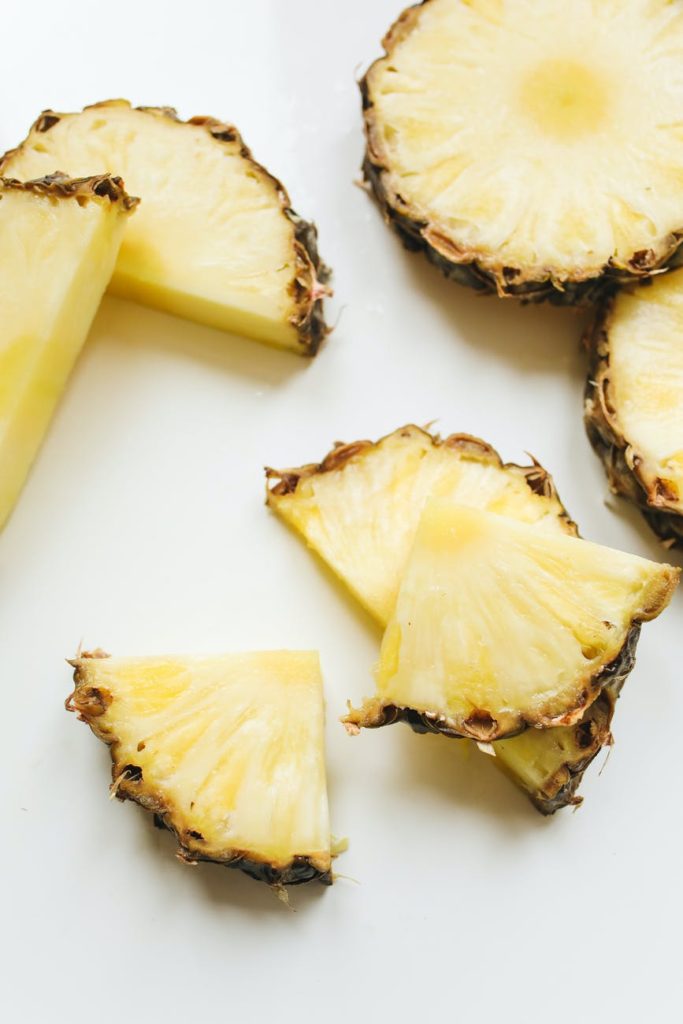
I picked up one for $2 this week. I usually buy one to two pineapples every single week when they’re in season, when I can find them, you cut off the top, you cut off the bottom. Then you take a sharp serrated knife and cut down the sides. Once you’re done you’re going to cut it in quarters and then cut it into little triangles, the tip here, which is the part that I just recently discovered.
And I did not know this and it is, I knew pineapple was rich in bromelain. And if you have ever, you know, tried some supplements for an antihistamine or, you know, any natural supplement products. For digestion, you are going to see the word bromelain in bromelain is this enzyme. And it’s one of those sulfur-containing, containing enzymes that are proteolytic, which means that it digests proteins and the enzyme aids in digestion, but this is the one that like stuck out to me. I was like, I’ve got to share this. It reduces inflammation and swelling. It breaks down mucous in the rest and respiratory conditions. Like pneumonia and bronchitis, it’s been used experimentally as an anti-cancer agent. The inflammatory agents in our bodies are actually inhibiting.
Because of bromelain and in clinical human trials, bromelain demonstrated significant anti-inflammatory effects, reducing swelling and inflammatory conditions, such as acute sinusitis, sore throat arthritis, and gout, and it speeds the recovery from injuries and surgeries. This blew my mind.
The part that’s most important to the pineapple is that middle core that most of us, I know I was, I was throwing it out, but that has all the bromelain in it.
Don’t throw that out. It’s a little tougher, but what I noticed when I started trying to eat the core, even my son can eat it now. If you have a ripe pineapple, that’s step one. But as it ripens in your refrigerator, that core piece will actually begin to soften. So this is just amazing. It’s an anti-inflammatory.
And when I say I noticed a huge difference with my sinuses and with how much I sneeze in the histamine reaction in my body, it has worked better than Claritin for me. So in order to get like all the benefits of the bromelain is you eat, you want to eat it between meals. So what I started doing.
Eating it as a snack about an hour or so before lunch, because if you eat it with food, it will aid in digestion. But the enzyme that bromelain it won’t be utilized by your body because it kind of competes for the food. So instead if you eat that in between meals, you’re going to. All of those enzymes and it’s also, and this is the last part because I was like, how, oh my gosh, like, God, God knows what he does and everything.
Right. And this is an excellent source of trace minerals, like manganese. It’s an essential cofactor and a number of enzymes important. And energy production and antioxidant defenses. So, I mean, can we just say, I want to encourage you this week, eat some pineapple cut off the top, cut off the bottom, use a serrated knife, cut off the sides and then cut it in quarters.
The easiest way I found was like cutting it in like smaller triangles after you quarter it, it makes that core a little more tender and you can also, you know, You can throw this in a smoothie. If you wanted to. I made one with coconut milk pineapple. And a little bit of protein powder, some ice, and a half of a banana.
And it was like a tropical dream in a cup. So eat some pineapple this week and get your Bromelain. So you’re going to want to just like potatoes. If you’re going to eat the skin, you’re going to want to wash your pineapple first. What I like to use honestly, is some water, some apple cider vinegar, and a little bit of baking soda.
And I just put that on a, what do you call those little vegetable brushes? Just like you would have for like a potato. And I just like, put that on there and scrub it a little bit, rinse it off, and then you want to do you’re cutting.
{Episode Continues } So it’s when we step in and we kind of try to manipulate things, not, we kind of try to, we manipulate things, whether on a, a caloric, restrictive thing or intermittent fasting or all of the different things that we have been told. Year after year, there will be something new tomorrow. There will be, there will always be something new because I believe that we’re so fascinated with food because it’s the thing that touches our life the most, which is why I truly believe that food can be medicine and can be nutritive and can be nourishing.
And I believe that God created it to do so. Because, you know, he created, there are things in foods that God has created fruit and vegetables and different things. Animal protein, there are things that God created for us to eat that literally have things that our bodies need and can’t make on their own.
There are essential oils that God has created for us to eat. So when we started stepping away from that, and we started trying to, when we started manipulating, you know, different things from our food and we’ve, it’s almost like we wanted to outsmart what God did. And create these, this way of eating.
That can be nothing but a bunch of chemicals and super highly processed, you know, food-like substances that we’re taking in and we start ignoring the things that actually count in our bodies that nourish us. So what nourishes us, phytochemicals, fiber, and different amino acids. You’ve got. Enzymes minerals, you know, carbs fats, proteins.
We have so many different things in our food that we can utilize as opposed to trying to manipulate. And that’s the point that I wanted to make on this particular episode. It can get so deep and so complicated.
I think the very first thing that we need to do in order to be healthy and to be well is to not focus so much on the outer appearance of things.
Style and Stewardship
But what actually is nourishing to our bodies?
And I truly believe the best place to start is to eat food and its whole state and cooking food. The way that we know. Helps our bodies digest, eating things that help our body digest food, getting in nutrients and enzymes that our body cannot make getting amino acids that our body cannot make from the foods that God created for us.
That is all I’m going to say on this particular episode, because in the next few episodes in the next couple of episodes it’s just so much to unpack and just one, and this is something that I encourage you to do, learn how your body responds to different foods, learn how your body responds to stressors.
And just like I said, in. The first, a couple of episodes ago, begin to focus on what is actually in your food as opposed to how many calories or what the macro content is or what, or, you know, just, we can’t do calories for calorie sake, macros for macro sake and, you know, dieting and trying to find this perfect template of eating because it’s going to be completely different for each and every one of us, depending on.
What we have been exposed to in our environment with the toxins and the different chemicals that we’re exposed to our bodies may need additional support in that area to help our bodies naturally detoxify. And I’m not talking about some detox diets. Don’t do those. You will hurt yourself. But God had created foods that go into our bodies that naturally help our bodies detoxify by scavenging free radicals that lead to a host of issues.
That, you know, give our bodies on the cellular level, what they need to function and do the process that God created them to do in the first place to, you know, clean up, you know, dead cells in our body. God made our bodies to do that every day. And it amazes me that we focus so much on what our scale says that we miss wellness completely.
There were times, especially like back in like high school. I did some extreme things to fit in my jeans sometimes. And just being real with you. I was sick as a dog. I was sick when I was in college and I waitress the whole time that I was there. I ate probably every preservative known to man, except for all the hundreds of new ones that have been created since just from eating packaged stuff.
And when you go to a restaurant, I’m going to tell you if you’ve never worked at a restaurant before you’re eating a lot of packaged food, it might come out on a plate and look like home, but you’re eating. Processed highly processed, highly preserved, highly you know, just exposed to all types of chemicals that you, you can’t even recreate.
Some of the tastes that you’re getting from, from the food that we eat out. Sometimes I’m not saying don’t eat out. I love to eat out. I’m a foodie, but you know, there are things that we can never, you know, recreate in our own kitchens. And that’s for a reason, there’s a reason why you can’t get your food to taste like theirs, there are so many different things that are added to our food.
PIN IT!
Now that we just, just have the information though, it can be somewhat overwhelming. I think it is a take-a-piece by-piece focus on whole foods first is the best way to start. And again, Good sleep and dealing with stressors the best way that you can, prayer is an awesome way to start. It doesn’t mean that you won’t still be stressed out, but, you know, God says for us to cast our cares on him.
And that includes all the things that we have been bombarded with in media, through, you know, the traditions passed down in our families or the way that we ate or, you know, some of the things that have been exposed to in our environment. You know, not going outside enough, not wearing some block. If we do go outside, there’s so many layers to this and it can be very overwhelming.
So I just wanted to encourage you to start right where you are.
And if you still have food in your house that you… I’m not one of those people that’s like throw all of that out and throw all that out. You paid money for it. There’s no like having an all-or-nothing mentality is one of the quickest ways to make you crave things and make you want things.
Hello, diet culture, you know, it’s just a cycle of being on a diet and then being off a diet because whatever you do has to be actually encouraging wellness, nourishing your body, and things that are sustainable for you to do.
And I believe that we’ve truly gotten away from what it means to eat sustainably, which is why I believe, our bodies are so out of balance.
Style and stewardship
Now, this is barring any, you know, sicknesses that we may have, or, or the different things that may happen to us because this is not a perfect world and we will get sick. But barring all of those things, the things that we can help, the things that we can do, I truly believe that having the information on what food does in our body and what chemicals do in our body, and how we’re actually treating ourselves and our families and what we’re eating and things like that have the biggest impact on us.
And it has the biggest impact on how well we can be. And it’s a one step at a time, one day at a time. This is, this is not a… I would just believe that the information is empowering and I hope that it does empower you, that it challenges you to start asking questions about where your food comes from, and where your meat comes from.
You know, if you eat, you know, whatever it is that you eat, where it comes from matters, how it, how it grew matters, what was sprayed on it matters. You know, what your, what the animal ate before you ate it matters. In what way it was killed matters. And it is taking these things one step at a time and week by week and just saying, what can I not get?
What, can I remove from my diet? We’ve done plenty of that. If you’re if you know what I’m talking about, if you’ve ever been on a diet, you have done plenty of removing things from your diet. I’m talking about what can you add into your diet? And when I say diet, I mean, just the way that you eat on a daily basis, what can you add into your cart this week that, you know, It’s healthy that, you know, has nutrients that, you know, has things in it that will nourish your body.
That’s what we’re getting at. And that’s what all of this is going to be about everything that I’m talking about. I get really passionate, really, really excited about this. I, I read a ton about this. Like literally my husband makes fun of me because I fall asleep reading textbooks on nutrition and human physiology and metabolism because.
Fascinating because I can’t not see God in it. I can’t not see how God created our bodies to function. Like, don’t even get me started on the microbiome. It is crazy. We will never, with the most brilliant minds that we have in this world, we won’t even scratch the surface of all that God has done in our bodies and the processes that he has made our bodies to perform and do.
Mind-boggling. We are, we are literal miracles. And it is just incredible to me that you know, we’ve gotten so far away from the way that God designed things. And we like to take things into our own hands. And we end up with sicknesses that many times are, you know, manmade or just man exasperated. Like we have exacerbated.
So many things and so much information just that we’re bombarded with. I would just encourage you to begin to ask the questions yourself for yourself, and then little by little, you know, researching different things. You know, there are so many things that are just a Google away, what’s the most important mineral for me to get?
What, how much, you know, should I, you know, I have my exposure. Like how does, you know, my exposure to pesticides affect me? Just like little things that you can do to just empower you, to make decisions and choices that will actually benefit your wellness and the wellness of those around you. That. So I think I’m going to put a pin in it right there.
And I cannot wait to talk to you a little bit more about this. If this has been an encouragement to you, I would love for you to share this podcast. I would love for you to just, you know, you can send me an email. Hello, at sound stewardship. If there is a nutrition or wellness topic that you would like me to cover?
Not that I’m an expert, but anything that I learn, I just, I love sharing it. I truly, truly do. It makes me so freaking excited. I can’t tell you how much to just share this with someone, hoping that it will empower you to make decisions. On your wellness journey in your wellness journey, that will benefit you tremendously and help you to nourish your body.
So it does what God created it to do. So until next time, your life matters, what you do with it matters. So what will you steward well?